Showing posts with label ancestor philosophy. Show all posts

Tuesday, July 06, 2010

Desecration of a Temple


Several months ago, I had the chance of accompanying one of my best pals to visit various Candi in Yogya. From him, I learned how people should respect Candi. He put off his shoes before entering the candi, went around the structure exactly 3 times, and really respect even the stone floor. Back then, he said to me that it is a sacred place for praying, and we should treat it as something really sacred. And at that time, my eyes were wide opened, that candi is really a sacred place, not just a pile of archaeological stones.

However, I faced a different situation when I had to escort my cousin to Borobudur several days ago. As people might know that Borobudur was one of the Seven Wonders in the world, it was supposed to be incredible. Moreover, it is also one of the biggest Budhist structures in the world, not to mention its unique configuration as a giant mandala to reach the Nirvana. I am not a Budhist myself, but with the background of Borobudur and its grandeur, it is expected to be respected.

When I got there, there was an announcement that people should not bring a food to the complex of the temple. Well, it was quite rational, since nobody would expect someone to eat in the mosque, church, or temple. And Borobudur is one of the famous temples.

But what did I found there? On the second level, I saw a family sitting in the corner and ate their meal there. They ate it as if they were eating in the park, not in a sacred place. Some of them are veiled women, while I shouldn’t judge them as super-pious, but it was a bit of a ironic scene, wasn;t it? Moreover, they threw away the garbage on the floor.

As a tourism object, surely many children visited the structure. But, most of them were not even interested in it. Well, not blaming them, of course, considering the nature of the children. But the parents themselves were not giving anything to their children. In their mind, they only consider Borobudur as a mere pile of stones from the time of long forgotten. Aaaargh! Does that mean they are allowed to desecrate it?

To make it worse, I accidentally overheard one of the tour guide explaining the relief. To my surprise, he told the tourists that the relief was about Shiva, one of the Hindu Trinity. Jiaah. Borobudur is a Budhist temple, and it’s not even related to any of the Hindu Cosmology. Where the hell did they found this brainless and uncultured guide?

The most ironic one is that, the foreign visitors even respected the temple more than Indonesian visitors. Gee, and what about the campaign of preserving our own culture? The younger generation showed no respect and interest to it, and how would they preserve it??

And with all the disappointment, I officially ran out of good words to write here. Let me stop, or else I might write bad things. Period.

Tuesday, September 16, 2008

Avalokitesvara 2 - Tara

Something weird just happened to me in last days. This is related to the little annoying childish devil (Wow, so now I’m using that term to refer to her?). Well, this is the case, she texted me once by using her-so-called-romantic-complicated-style of poetry text. And hey, for people knowing me well, I am always tempted to reply that kind of text, using my own complicated thingy. Well, kind of showing off that I can make something more complicated than that! Wahahahaha!!!!

She texted me about Sita and such, taking excerpt from wayang. I thought, wow, so she wanted to have a “duel” in this realm? So I replied by comparing Sita, Banowati, and Drupadi. Guess what, she said that she knew Banowati. Gee, I doubted it actually. Again, she replied using that kind of register, her so-called-wayang-register-but-actually-too-shallow. So, I challenged her by mentioning Avalokitesvara and Tara. Hit the spot, dude! She didn’t know who Tara is (in fact she thought that Tara is the one having hundred kids! Dude! That’s Gandari!!!) Few days ago, she said that I shall never get my Tara. Geee, I never try to look for Tara. See, with that childish mind of her, again, she misunderstood.

Okay, enough with the introduction. Let’s just see who is Tara here!

Tara is not the husband of Sugriwa. She is not the one who is the daughter of Indra. Instead, Tara is the avatara of Avalokitesvara. Legend mentioned that she is born from Avalokitesvara’s tears when seeing so many creatures in-need of help. Though she’s powerful, she still can’t do it alone. Thus, born Tara. Tārā is also known as a saviouress, as a heavenly deity who hears the cries of beings experiencing misery in samsara, She is the consort of Avalokitesvara, and also devoted her life to help others.

In Buddhist pantheon, it was said that there are 21 taras, each with their own specification. Below are the most famous incarnation of tara

Green Tārā, known as the Buddha of enlightened activity
White Tārā, also known for compassion, long life, healing and serenity; also known as The Wish-fulfilling Wheel, or Cintachakra
Red Tārā, of fierce aspect associated with magnetizing all good things
Black Tārā, associated with power
Yellow Tārā, associated with wealth and prosperity
Blue Tārā, associated with transmutation of anger

Last word for that little devil, I’m not looking for Tara to be my partner. It’s just a figurative expression. But thanks to Tara, I can get rid of you!
Om tare tutare ture Svaha!

Monday, August 25, 2008

Avalokitesvara 1 - Unconditional Love

Avalokitesvara a.k.a. Guan Yin a.k.a. The Goddess of Mercy is one of the most famous deities under the heaven. Many have acknowledged her position and role, even dramatized her in countless literatures. And what does she do anyway to deserve such devotion from many beings?

As the name might suggest, Avalokitesvara is the goddess of mercy and compassion. She actually is one of the bodhisattva, a being close enough to perfection, a step away from reaching mokhsa. However, most bodhisattvas are delaying their perfection in order to help other creature to reach the same state with them. Even more, Avalokitesvara gave an unconditional love, which is giving away her state of purity to save other beings. This role places her as the highest bodhisattva, the saviour of the world from impurity and corruption.

She is willing to take any karmic consequences of her action in helping other. Her consideration of striking is based on compassion, not on the basis of profit for herself.

The greatest story of Guan Yin’s sacrifice came from one of its origin stories, Princess Miao Shan. It was told that she wanted to devote her life for esotheric journey, to leave earthly matters behind her. Her father, the emperor, was furious with her decision. In order to prevent her leaving the castle, he threw her to do dirty works in kitchen, thus degrading her status as royal princess. She successfully did those tasks and lived at a monastery as bikhuni. Feeling annoyed and degraded, the king sent his envoy to burn down the monastery, effectively killed hundreds bikhuni. Miao Shan herself was saved by the tiger and brought into the mountain.

During her stay at the mountain, she kept training and meditating. Away from the earthly matter, Miao Shan finally reached the enlightenment.

Meanwhile, the king was burnt by his fury. This in time turned into a mysterious disease. The only medicine involved eyes and hand of a living being, given voluntarily without any force. The royal family tried to find a donator for that, and they ended up with a female hermit in the mountain. She agreed to donate her eyes and hands. When the royal court saw her, they recognized her as Princess Miao Shan. The king and queen bowed down to ask for forgiveness from her, having exiled and tried to kill her out of rage. Miao Shan nodded gracefully and started to plug out her eyes and cut her hands. When her parents received it, she then transformed into thousand-handed Avalokitesvara for a moment. In the following moment, she turned back into a female hermit and died.

This action is interpreted by many people as Miao Shan’s effort to protect her father, to cast away all causes of pain, namely hatred, attachment to the worldly things, misunderstanding, and blinding rage. Her piety towards her parents was manifested infinitely, by accepting the seemingly impossible tasks, murdering effort, without any hard feeling. She even gave her life to save her father unconditionally. This in turn, made sure that her father repent and follows the path of mercy and compassion.

The imagery of Avalokitesvara with thousand hands and eyes given in Miao Shan’s story symbolized her all-knowing trait. This figurative is also related closely with his eleven heads. The heads and eyes mean her watching over us from many angles, aspects, and condition. Her hands indicate her willingness to give us a hand, to help us, to assist us in time of most unfortunate.

Avalokitesvara a.k.a. Guan Yin doesn’t limit herself only to Buddhist people. She is not only a deity for Buddhist. She in fact is the manifestation of pure compassion. She is the unconditional love, the universal mercy, reflected in many religions before us. This love is given name Avalokitesvara by Mahayana, manifested as Virgin Mary in Christianity, known as Sarasvati in Hinduism, taking form of Kerridwen in Druidism, and Mother Earth in many paganism beliefs.

This thus ends the first part of Avalokitesvara, Om Mani Padme Hum……..

Thursday, July 31, 2008

Sitting in the Court of Buddha

My cousins happened to stay at my home yesterday (30/07). Since it was holiday, my mom asked us out for a trip. At first, she wanted to go to Tritis. FORTUNATELY, Ndy and Sien had been there before. (Yuck! Can you imagine me going on a pilgrim to a holy sanctuary??? I might not be able to make it back in a whole body! Hehehehe!). So, as the alternative, I asked them whether they’ve been to small temples around Yogya or not. Turned out, they never went there. Thus, it was decided that we would visit Candi Sambisari, Candi Kledulan, Candi Sari, and Candi Plaosan. Actually we also planned to go to Candi Ijo and Candi Kalasan, but those kiddos were tired already………
Not much to say about Candi Sambisari. It is very beautiful, safe, well organized, but very sterile. Umm, Sterile? Well, in some extends, it felt very ‘safe’ and doesn’t have that many ‘things’. Ehehehehe!

Candi Kledulan? Well, it was still excavated though. So, we only saw the excavation site. Good for the kiddos, though. They can see the process of excavation. Sien even said that the process of reviving the temple is just similar to the process of constructing humongous puzzle. Hehehehehe!

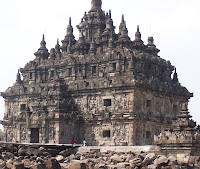
Candi Sari gave us creep. Well, not that it was totally creepy; it was very solemn and silent indeed. Cold and breezy indeed. However, I felt some slight of chill when looking at the left chamber. Something startled me, but I just didn’t know what it was yet. So, I decided to enter the right chamber first, along with everybody. It was very calm and soothing. I went to the left chamber together with my dad. It was darker than the other chamber though, and the atmosphere was so tight. I realized which part startled me there. It was the hole for the missing statue under the Kala Makara. Later outside, I heard Ndy said to us that she saw someone very big at that very spot, under the Kala Makara. She didn’t have the courage to re-enter the temple, so I did with mum. Yes, the guardian was there, the very old and powerful one from the ancient era of that temple’s glorious moment. He’s still there, standing firmly.
We continued to Candi Plaosan. Well, I didn’t have that much expectation though. As far as I knew, it was just another small temple in the rural area, just in the same level of Candi Sari, Sambisari, Kalasan, and such. However, a twist happened. It grew! The second temple was almost finished built. The foundation of the third main temple was found. Many candi perwara has been restored, and the air photo showed that the whole complex of this Candi Plaosan, along with its vihara like that in Mendut, will be bigger than Borobudur or even Angkor Wat. And the small temples around it were many and in a relatively small distance among another. So, if everything is restored, then this will be biggest ancient temple complex in the world so far. The grandeur of this complex is totally astonishing. I can even imagine how this complex used to be, the centre of the syncretism between Hinduism and Buddhism, the destination of pilgrimage, a hidden library of philosophy, and a great school of life, along with many scholars and monks.

Enough talking about the grandeur of the construction. As I entered the only opened main temple (sure, one is being reconstructed, and one is only the foundation yet!), I saw another three-chamber-temple. Nothing like Candi Sari though. Every chamber was so grand, with a couple of Buddha statues of different rudra. Those two statues each with different persona, anima and animus. One was big in built, and the other one is slimmer, just like a queen and a king, though all the statues were representing male Buddha Avalokitesvara. The atmosphere was very much like a palace.

Now, to the most interesting part of the story! The third main temple. As you know from my story, it was only a foundation with no wall. However, there were 21 statues of Buddha, each with different built. They were formed in some kind of court formation. Seven in front and five in each side. You could even say that they were having meeting, with Gaotama as the centre (the position of the leader). Too bad, the broken statue of Tara, the only female Buddha (yet also regarded as the avatar of Avalokitesvara according to the ancient syncretism belief) was not put there. The other statues were not complete either.

I walked around the statues, looking each one carefully. From the slimmest figure to the fattest one (Was the fat figure supposed to be the Laughing Buddha?), examined Gaotama in the centre (so far, this is the most complete statue, and the only figurative close to the original Buddha, while the others are the usual figurative of Javanese Buddha!).

Tempted by the unusual atmosphere, I tried to look for the centre of the circle. Quite easy, since there were some pointer there. Taking a straight line from Gaotama statue, I stood at that spot. IT WAS AMAZING! You will feel like you were standing in a royal hall surrounded by the court of Buddha. You could also feel the power and force. Ever saw Monkey King, in the scene of Heaven Court? That was like it!

Something inside me said that I should sit at that spot. I did sit! However, the voice said that I should sit in a meditation pose. I felt very comfortable, but my other side was frightened. I even felt like closing my eyes and started meditating. I know that I should do it, but at the same time, I was also afraid that I couldn’t get back to my body, to reality. Yet, I decided to close my eyes for some seconds. It felt very calm and comfy. I snapped my consciousness and promised to get back to the complex later on.

At home, I contemplated and rethink that experience. And I realized, the forces there are even older than those usually absorbed by other people seeking for power. Older than the forces in the imperial palace. You could even say that this is an ancient force in its purest form. Seeing from the origin of Plaosan, we may conclude that this force is the result of puja, a very constant and sincere puja.

Wew!

Monday, June 16, 2008

Illusion, Marriage, and Relationship


From the last peer teaching session during my training at LISDU (Language Institute Sanata Dharma University), there was some story left to share.

It was a training session to teach the advance students. In the advance class, most of the activities are discussion and discussion. There were three turns for us to teach (fortunately, it was not my turn), with the same material. Marriage problem. The ones who don’t teach were asked to be students from different major and academic background. Being a weird guy, I chose three different queer backgrounds during the turns. At first, I was a theology student. Second turn, a philosophy student. Last one? Accounting student! Each background influenced my answer and attitude towards the problem…. (Imagine an accounting student who said that marriage is in fact an investment! The beneficial one!)

However, what I want to say here is what I reflected on my own saying during the second turn. As a philosophy student, I tried to relate my answer to the philosophers. Unfortunately, I couldn’t recall many. Only Buddha came to my mind. Thus, when Nov asked me, “What is the most common problem in marriage?” I answered quite weird.
“I think the problem is that people are trapped within this whole concept of marriage and relationship. Marriage and being in a relationship are so overrated nowadays! Those are man-made, and don’t need to be regarded very highly. Don’t fuss over it too much! Man-made is never eternal, and basically hardly anything is immortal. Everything is just an illusion!”

I DID SAY THAT, trust me! Incredible!

This made me stunned. On the way back home, I tried to digest those words. Everything is not perpetual, only a mere illusion. If so then, what is our goal in life? Nov asked me that too in class. Moreover, she also asked what I want to achieve. “So, basically you just want to go with the flow? That you don’t want to marry someone?”

“I didn’t say that I want to live celibate. I will probably marry. Marriage is important in human life, but not that important. One day, you will lose it as well. So, why cling too hard on it?

“The ultimate goal is not to avoid any ‘illusion’, but to shift your perspective. That nothing is everlasting. The ultimate goal is to look for the Nibbãna, the state in which you are free from anything. From any dukkha, from any sańkhãra. The state in which you don’t feel any suffering or excitement. The eternal and true happiness!”

Yeah, I also wonder, how could I say that????? BIG QUESTION MARK! What was into me then?? To think that it is very hard to release ourselves from these material thingies!

She asked me again, how I live then.

Central way, that was what I said. By neither following the material world nor choosing complete avoidance. Later, I found the best example from Samyutta Nikãya. The way to cross flooded river is to keep going, not stopping or fighting against it. That we need to get through everything, but not too absorbed into it.

It’s not the total exile! It is not total absorbance either.

My mum laughed out loud upon hearing my story then. But she then said, “Can you do what you have said?”

OUCH! That’s hurt!

Lastly, I still wonder how did I say that???? I said it without thinking… Really, really… I just don’t know myself…..
 

Friday, June 13, 2008

Li ba shan xi qi gai shi
Shi bu li xi zhui bu shi


Zhui bu shi xi ke naihe
Yuxi, yuxi, nai ruohe


(Translation :
Strength I had to uproot hills, my spirit dominated the age
Now in this hour of misfortune, my dapple steed cannot flee

Dapple steed, unable to break away, what hope is left?
Ah Lady Yu, my Yu, what will become of you?)

I’d like to share this beautiful poem I found in the chinese poem collection. Well, this might not be completely beautiful for you readers. The poem is actually about desperation after long, long fight.

This “Gai Xia Ge” or “Song of Gai Xia” is about Xiang Yu’s desperation after the betrayal of his underlings which led to his defeat. He lost all of his spirit to keep on fighting, even forgot his own pride as a warrior. In such time, his consort, Lady Yu Jin drew his sword and cut her own neck. Her last words were, “If even the mighty Xiang Yu has lost his will and spirit, then there would be no more meaning in living!” This event slapped Xiang Yu hardly. He realized that as a warrior, whatever happened, he must not lose his own pride. Even in the verge of destruction.

The pride in defeat. What the hell is that? Does that mean we have to be proud to lose? Hummm, not exactly like that.

This pride and honour are things rooted deeply in the ancient legends of China and Japan. Perhaps, somewhat complicated and unacceptable for some people nowadays. However, this is not a bad thing though. We can learn something here.

Of course, it doesn’t mean that we have to completely kill ourselves when losing just like ninjas and samurais in Japan. Nope. This is more to the fact that we keep holding what we believe in, we keep struggling for what we hold, despite the condition and situation. Even we are defeated, accept the defeat in grace, and end it in a glorious and memorable way. The most shameful action for warriors is to beg for his life, to beseech for safety and instantly throw away what he had believed in for a longer age. Humh! At least, if you change your mind, do it not for the sake of your life!